Carillon Music and the Art Installation “The Light of the Crown” Will Invite Visitors to Discover Queen Morta on Statehood Day in Šiauliai
Organised by Šiauliai Culture Centre. The project is funded by the Ministry of Culture of the Republic of Lithuania and Šiauliai City Municipality. The event is free of charge.
On 6 July, Šiauliai will become one of twenty locations in Lithuania and abroad where projects dedicated to Statehood Day and funded by the Ministry of Culture of the Republic of Lithuania will be implemented. Among the initiatives that received funding is the Šiauliai Culture Centre project “Carillon for Queen Morta: The Light of the Crown”, which aims to highlight the role of Queen Morta in the history of the formation of the Lithuanian state through professional music, contemporary art and cultural experience.
The cultural initiative invites visitors to look back at one of the most prominent figures in the formation of the Lithuanian state and recalls the historical assumption that before becoming Queen of Lithuania, Morta was the wife of Vismantas Bulionis, one of the dukes of the land of Šiauliai. This connection allows us to view the beginnings of the state not only through the personality of King Mindaugas, but also through that of Queen Morta.
“Statehood Day is most often associated with King Mindaugas, but Queen Morta also holds an important place in the story of the beginnings of the Lithuanian state. Little historical information about her has survived, so we want to bring this figure to the forefront not only through historical facts, but also through music, light, art and symbols of statehood. Through this project, we invite people to take a broader look at the period of the formation of the state, remember the first Queen of Lithuania and, through culture and art, encourage interest in the origins of the Lithuanian state,” says Deimantė Bačiulė, Director of Šiauliai Culture Centre.
One of the most striking highlights of the initiative will be the mobile carillon arriving in Šiauliai from the Museum of Gdańsk – a musical instrument consisting of tuned bells and played using a special keyboard. The Gdańsk mobile carillon has 48 bells and is one of only eighteen functioning mobile carillons in the world. In Europe, carillon music has long accompanied city life, national celebrations and solemn ceremonies, so on Statehood Day its sound will symbolically connect the history of Lithuanian statehood with the European cultural tradition.
On 6 July at 4 p.m., a mobile carillon concert will take place in the square next to Šiauliai City Municipality, featuring carillonneurs Dr Monika Kaźmierczak and Witold Maciak from the Museum of Gdańsk and Lithuanian carillonneur Ignas Vydeika. The mobile carillon’s visit to Lithuania is organised by Šiauliai Culture Centre together with Viekšniai Culture Centre of Mažeikiai District, so on Statehood Day this exceptional concert will be heard not only in Šiauliai, but also in Viekšniai.
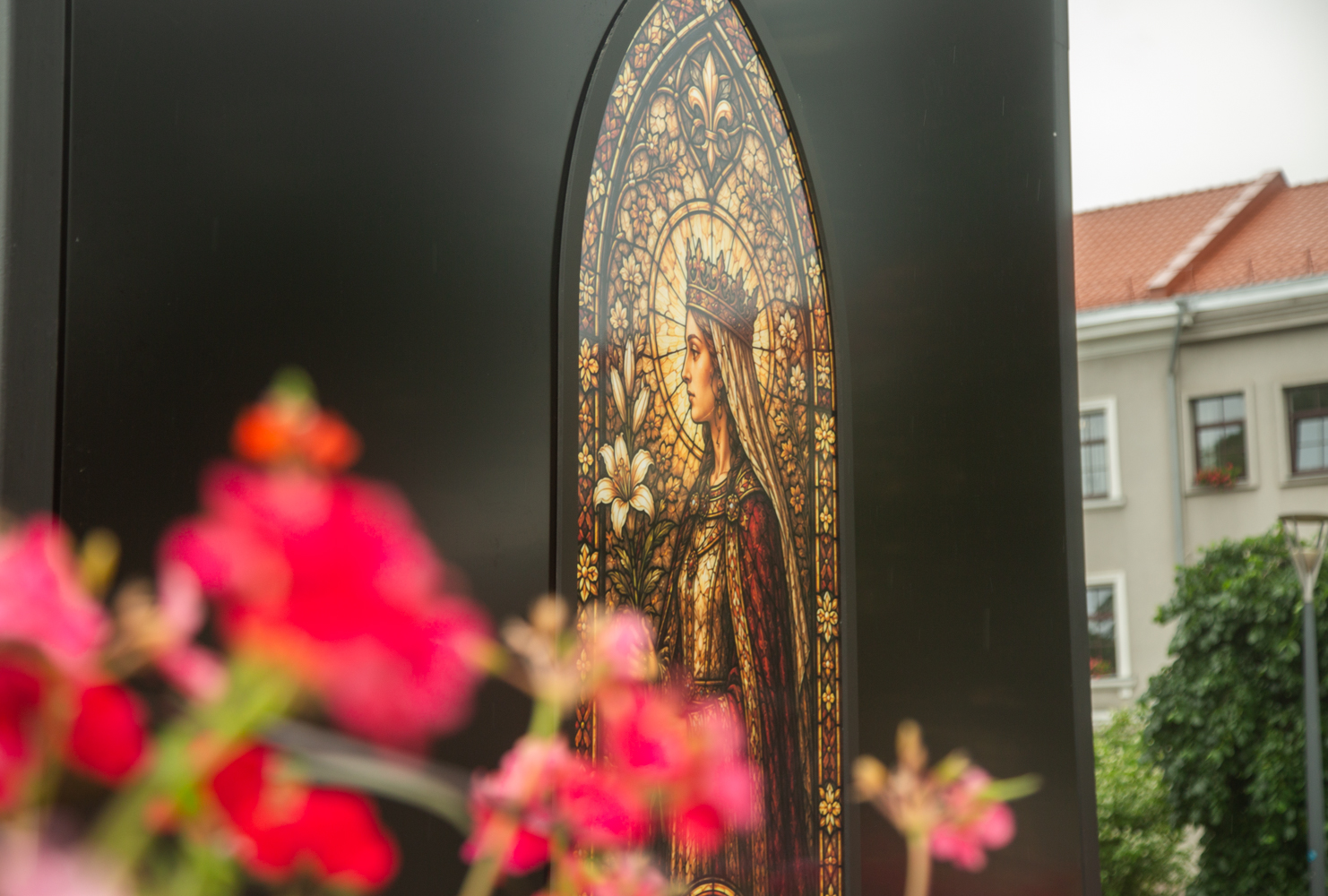
The sound of the carillon will be enhanced by the art installation “The Light of the Crown”, which will be on display from 6 to 26 July. A symbolic pathway of 30 pennants will lead to the installation, with symbols of the crown and oak representing power, baptism, strength and the meeting of two worlds – paganism and Christianity – at the dawn of the Lithuanian state.
At the heart of the installation is a monumental cube, a symbolic dedication to the first Queen of Lithuania. At first glance, its restrained and enclosed form conceals an inner narrative space. Upon entering, visitors will see stained-glass images of Mindaugas and Morta, a crown, and hear an audio narrative created especially for this installation, inviting them, through the symbolic voice of Queen Morta, to reflect on the beginnings of the state, responsibility and cultural memory. Light, sound and imagery will merge here into a unified artistic experience, allowing visitors not only to learn about history, but also to experience it.
On 6 July, the cultural initiative “Carillon for Queen Morta: The Light of the Crown” will become one of the most prominent parts of the Statehood Day programme in Šiauliai. It will invite visitors to stop, listen to the sound of the carillon bells, enter a space filled with light and history, and, at least for a moment, take a fresh look at the period of the formation of the Lithuanian state.
The full programme of events can be found on the websites of Šiauliai City Municipality (www.siauliai.lt) and Šiauliai Culture Centre (www.siauliukc.lt).
Information is provided by Deimantė Bačiulė, Director of Šiauliai Culture Centre, mob. +370 671 42 889, deimante.baciule@siauliukc.lt.
Photos by Liubov Yarmoshenko and from the archive.
Atnaujinta: 2026-08-21 11:14