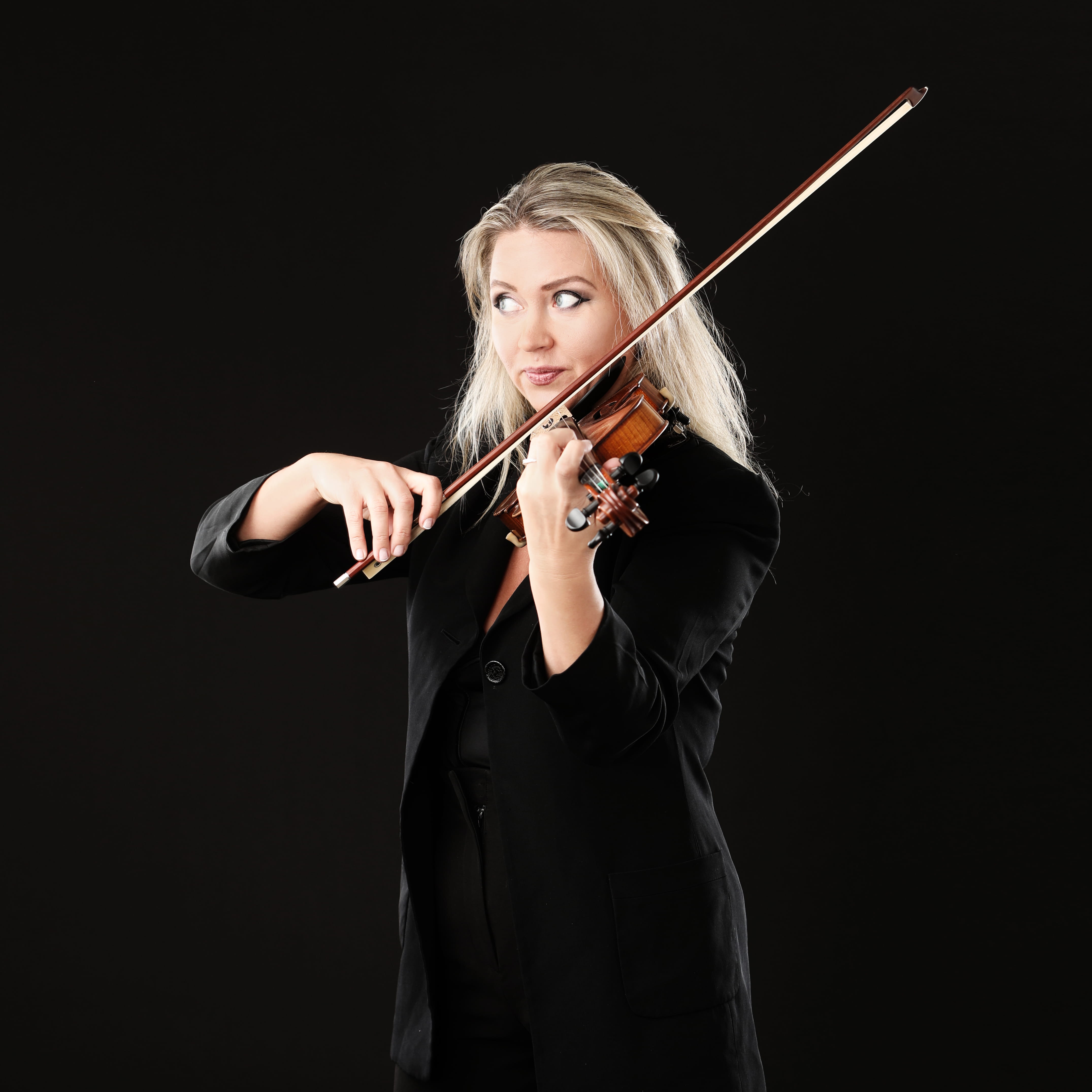
Šiauliai Anniversary Year Honorary Ambassador Eglė Jarkova: “I Want to Be a Person Who Builds a Good Name for the City Through My Work”
You began your musical journey at the age of three. First singing, then the violin from the age of five. And at eleven, you had already left to study in Vilnius, at the National M. K. Čiurlionis School of Arts. Many would say you did not have a childhood. Did you ever play with dolls?
E. J. I remember my childhood as very beautiful, only somewhat different. My playmate was often the violin, but that did not mean I did not have a childhood. I played, dreamed and enjoyed little things just like all children. I simply understood very early that music was not just a hobby for me – it became my path in life.
Leaving for Vilnius at the age of eleven was a big step, but also a tremendous gift. Of course, at the time I did not understand how much courage it required. Now I look back on it with gratitude to my parents, teachers and all the people who believed in me.
What memories connect you with your hometown of Šiauliai?
E. J. One of my most vivid childhood memories is of summers in Šiauliai. From first grade onwards, almost every summer day I would go to the Second Music School to practise. Even when I was already studying in Vilnius at the National M. K. Čiurlionis School of Arts, whenever I returned to Šiauliai for the summer, I would once again walk to my music school every day. The director and teachers allowed me to use the classrooms, so I was able to continue working during the summer holidays. This continued until I left to study in Italy. Now I understand what a tremendous gift that was and how much the people who believed in and supported young musicians contributed to my journey.
My childhood is also inseparable from our garden. I remember picking berries, doing various chores and spending weekends in nature. It is true that sometimes I was granted a special “privilege” – I was excused from weeding the garden so that I would not injure or damage my fingers. At the time, it seemed completely natural, but today I understand how much love and care lay behind that decision by my parents.
Šiauliai has always remained the beginning of my story. My first years of life, my first music lessons and my first concerts all took place here. Although life took me to Vilnius, later to Italy and Boston, and to many other places around the world, the feeling of my hometown never disappeared.
Are there still people close to you in Šiauliai whom you want to return to?
E. J. It feels very good to know that my parents still live in Šiauliai. Every year, when I return to Lithuania with my daughter, who is now eight, she spends a few days with her grandparents in Šiauliai – alone, without me. It is very important to me that she has the opportunity to build her own relationship with the city where my story began, to get to know her grandparents, and to experience the same sense of peace and warmth that I experienced here as a child. To go to the same garden, the same lakes and now to a city that has been greatly renewed.
What gave a young woman the courage to leave to study in Boston? And what was the most difficult part of living abroad?
E. J. To be honest, my arrival in Boston was very unexpected and completely unplanned. After finishing my studies in Vilnius, I had won a scholarship to study in Italy and at the time imagined my future in Europe. Professors from Boston had come to Italy, I participated in their masterclasses, and after they ended I received an offer to come and study in Boston. I was awarded a full scholarship – both for tuition and living expenses. After two years in Italy, I left for Boston. With two suitcases and a violin. I had never planned to go to the United States. But somehow curiosity won. I left thinking that if it did not work out or I did not like it, I could always return to Europe.
Sometimes the most beautiful turns in life happen when we do not plan them at all. I think curiosity often overcomes fear. I very much wanted to grow as a musician, learn from the best teachers in the world and discover a broader musical world. Such an opportunity was a tremendous gift.
The hardest part was longing – for family, home, the Lithuanian language, food and the people close to me. Living abroad makes you realise how strongly your roots shape you. That was when I came to appreciate Lithuania and where I come from even more.
You are a very busy person, yet you find time to take part in the activities of the Lithuanian community. Is it for yourself, out of a sense of duty to the community or for your daughter? What does it mean to be Lithuanian while living abroad?
E. J. I think all of these things are connected. When you live abroad, you realise how precious language, culture and traditions are. You want them to remain alive not only within us, but also in the lives of our children.
The Lithuanian community in Boston is large and very diverse – different generations and different stories come together there, yet everyone is united by love for Lithuania. Although my intensive teaching life certainly does not always allow me to take part in every event, I try to contribute as much as I can. I have performed several times at the Lithuanian church in Boston, and my daughter attended the Boston Lithuanian School at the ages of five and seven and took part in community events. It was important to me that she grew up hearing the Lithuanian language, learning about our traditions and feeling that Lithuania is not only a place on the map, but also part of her identity.
I also organise concerts in Boston and always invite members of the Lithuanian community – those who feel close to culture, art and music. I also greatly value my connections with Lithuanian creators living outside Lithuania. I am in contact with artist Samuel Bak, who lives in Boston and whose works are exhibited at “Pucker Gallery”. Such encounters remind me once again that Lithuanian culture is alive throughout the world and can inspire people regardless of where they live.
To me, being Lithuanian abroad means more than just speaking Lithuanian. It means carrying Lithuania in your heart, presenting it to the world through your work and taking every opportunity to remind people how rich our culture is. Music is a wonderful language for that – it has no borders.
The International Summer Music Festival “Vivace Vilnius” is being held for the fourteenth time this year. Do you envisage organising concerts in Šiauliai during the festival in the future or involving young Šiauliai talents in the festival programme?
E. J. The last time I performed in Šiauliai was in 2012 – very symbolically, because that was also the first year of the “Vivace Vilnius” festival. Now, after thirteen years, I am returning with the festival, with young talents and with an even greater desire to share music. This return is very emotional and meaningful to me. I would very much like this concert not to be a one-time meeting. From the very beginning, the “Vivace Vilnius” festival was created to connect people, generations and talents.
If opportunities arise, I would very much like to collaborate with Šiauliai, invite young musicians from the city to take part in festival activities and create new traditions together. It would be very meaningful to me for my hometown to become part of this story.
Every year, if I receive an application to the “Vivace Vilnius” masterclasses from a pupil or student from Šiauliai, I always accept them. It is very important to me to give young people the opportunity to learn from distinguished professors coming from different countries around the world, to meet inspiring musicians and to perform in major concert halls in Vilnius. Sometimes one such meeting or one opportunity can change the direction of a young person’s life. I believe our responsibility is not only to pass on knowledge, but also to open doors for those who dream. Creating opportunities for the younger generation is precisely one of the most important missions of “Vivace Vilnius”.
How do you imagine your mission as an honorary ambassador of Šiauliai during its anniversary year? Is it more of an honorary title, recognition of your work, or does it also mean additional commitments and greater responsibility?
E. J. For me, first and foremost, it is a great honour and sincere recognition. But at the same time, it is also a responsibility. It is important to me that when people meet me around the world, they hear not only about my work, but also about the city where everything began.
I am grateful to Šiauliai for my first steps, so I accept this title with great respect and I want to be a person who builds a good name for the city through my work.
It is very symbolic to me that after thirteen years I am returning to Šiauliai not alone, but together with young musicians. The “Vivace Vilnius” festival was born from a desire to share music, inspire young people and create a sense of community. Therefore, this concert is not just another performance for me – it is a very personal homecoming. I hope it will become the beautiful beginning of a renewed connection with my hometown.
Your life journey and your courage to create and act have led you to international experiences and recognition. What would you wish for the people of Šiauliai?
E. J. I would wish for them to believe in their city and in themselves. Sometimes it seems that big dreams are born only in the great cities of the world, but my story began right here in Šiauliai. I am convinced that what matters most for talent is not the place where you were born, but curiosity, perseverance and people who believe in one another.
I would like to wish that Šiauliai continues to nurture courageous, creative people, and that all of us remember to return to the place where our journey began. I believe that homecomings are among the most beautiful moments in life.
Photo by Diana Levine.
Information is provided by Edita Smindriūnaitė, Head of the Exhibitions Department of Šiauliai Culture Centre, tel. +370 656 13 886, e-mail edita.smindriunaite@siauliukc.lt.
Atnaujinta: 2026-08-21 11:41