For Lithuanian State Restoration Day – The Painting Legacy of Antanas Martinaitis (1939–1986)
The organizer is the Šiauliai Cultural Center. Admission to the opening event is free.
Antanas Martinaitis remains one of the most distinctive and expressive figures in Lithuanian art history. A painter, poet, and teacher active primarily in Kaunas, he left behind an exceptionally rich and diverse artistic legacy during his relatively short creative life – including paintings, drawings, watercolors, pastels, poetry, and prose.
From childhood, his worldview was shaped by an artistic family environment: his father, Jonas Martinaitis, was a watercolorist and caricaturist, while his mother, a teacher, encouraged his creative pursuits from an early age. His mature style formed in the mid-1960s, as the dominance of Socialist Realism began to decline. The artist was increasingly influenced by the ideas of the interwar expressionist group ARS, as well as traditions of Post-Impressionism, Expressionism, and Magical Realism. His work drew inspiration from Lithuanian folk art, mythology, fairy tales, poetry, childhood memories, and the lyricism of the Lithuanian landscape.
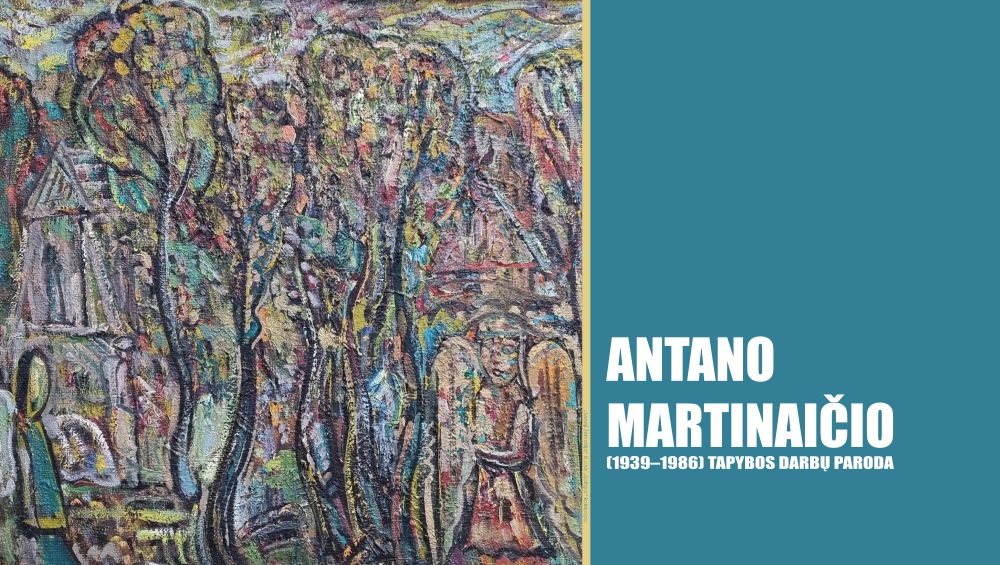
Martinaitis’ painting is characterized by a monumental yet lyrical visual language. His works reveal multilayered compositions, rich textures, and dynamic painterly structures in which figures and objects merge into a unified, pulsating whole. Beneath the apparent vibrancy of color lies a strong draftsmanship, clear composition, and carefully considered painterly order. His art is marked by metaphorical expression, subtle color harmony, and an inner radiance in which color becomes the primary means of shaping form.
In his landscapes, the artist portrays not so much a specific view of nature as the sensation and memory of experiencing it. Dense layers of trees, shrubs, branches, and blossoms fill the canvas, leaving little open perspective or distant horizon. The viewer’s gaze wanders through a labyrinth of lines and colors, exploring surface, texture, and rhythm.
In figurative compositions, characters often appear gathered on a narrow stage-like space – before or after a performance. Standing in rows, they do not run, dance, fall, or even touch. They seem frozen in mysterious ceremonial moments, where everyday reality subtly dissolves. For Martinaitis, there was no strict boundary between reality and fairy tale.
As a writer, the artist placed great importance on the titles of his works and their narrative power. Although at times he approached abstraction, he never abandoned the depiction of figures, landscapes, or objects. Martinaitis remains a storyteller – creating a celebration through color and form, beneath whose veil one can often sense both pain and the premonition of death.
The exhibition will run until March 15. Admission to the exhibition is paid. Ticket price – 2 EUR. Information about discounts is available at Gallery “Laiptai.”
Opening hours of Šiauliai Cultural Center Gallery “Laiptai”: Tuesday–Friday 11:00 a.m.–6:00 p.m., Saturday 11:00 a.m.–5:00 p.m.
Photo: Darius Ančerevičius / Collection of Algimantas Jankauskas (except the main visual).
For more information, please contact Kristina Alseikė, Event Organizer of the Exhibitions Department at the Šiauliai Cultural Center, tel. +370 658 80 507, e-mail kristina.alseike@siauliukc.lt.
Atnaujinta: 2026-02-12 15:13