Saulius Saladūnas’ Photographs Return to Childhood Memories
Organizer – Šiauliai Cultural Center.
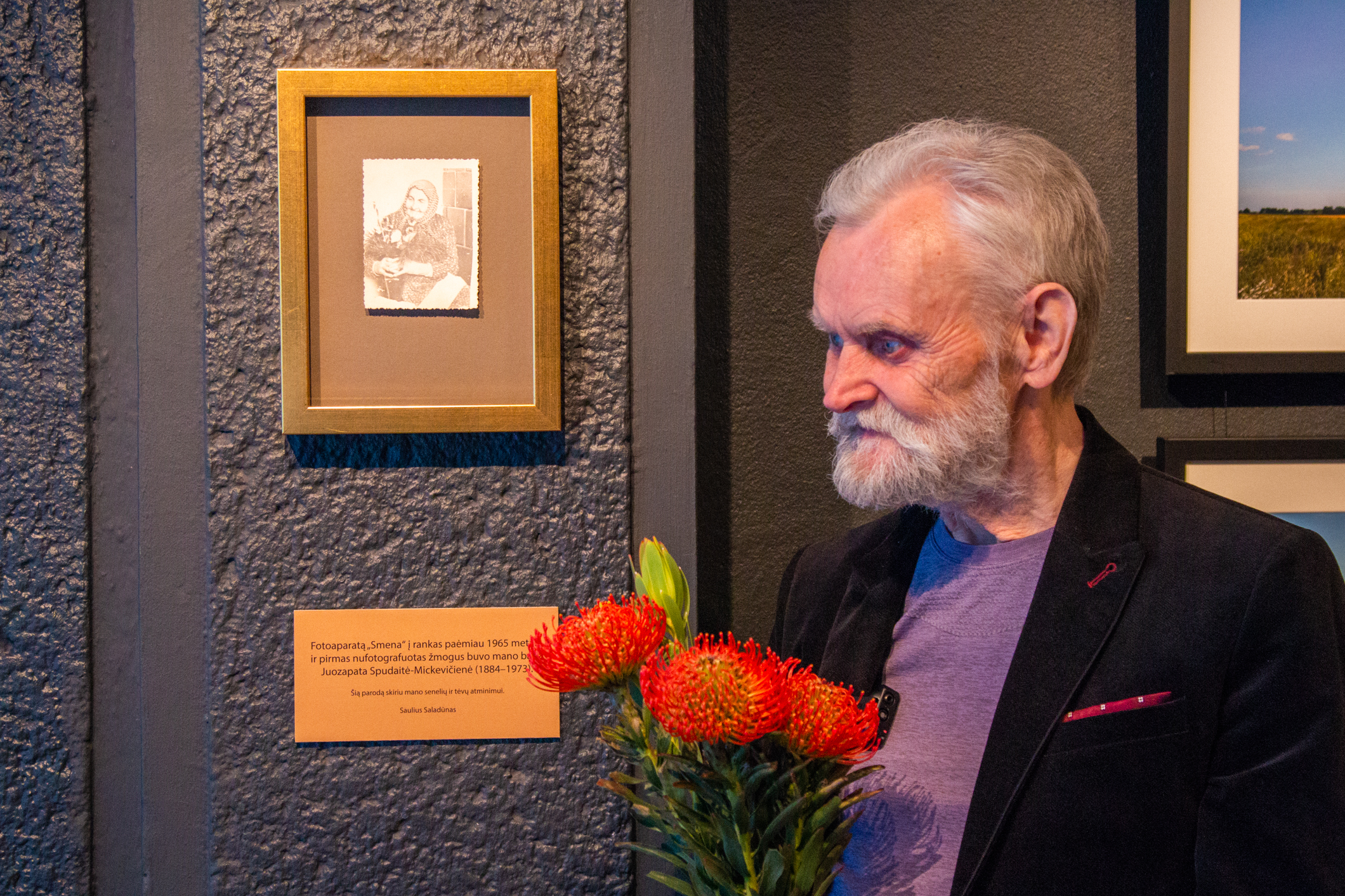
Last autumn, Saulius Saladūnas celebrated a double anniversary—his 75th birthday and six decades of faithful companionship with a camera. Although life circumstances repeatedly attempted to lead him in other directions, from the very first photograph of his grandmother to contemporary ecological performances, Saladūnas has remained devoted to photography. For him, photography is a way of life that enables a dialogue with the past, a reflection on the present, and an invitation for viewers to contemplate their own experiences.
The mirages of the past and their relationship with the present are also reflected in the exhibition “Reconstruction of Memory After 55 Years: About My Grandmother and Myself.” The photographs capture not only specific images but also their atmosphere, sensations, and the author’s inner connection to what was once experienced. Here, the camera becomes a tool for returning to fragments of the past and rethinking them anew—as if reconstructing what has long disappeared from physical space but remains alive in memory: meadows of blooming wildflowers, a distant horizon lined with trees, the grandmother’s homestead, and the road leading to it. Though they no longer exist, they continue to live in the author’s recollections.
“My memories come from a period when I was about five, six, or seven years old. That is why I wanted to create these photographs through a child’s eyes—not sophisticated, not complicated, without special angles, but simple. When you are only about a meter tall, you photograph what you see. But how do you photograph something that no longer exists? Neither those places nor the feeling of childhood remain. So why not reconstruct memory and allow yourself a little fiction?” the author reflected during the exhibition opening.
Philosopher Jurgis Dieliautas, who presented the exhibition, noted that Saladūnas’ photographs should not be viewed as documentary narratives but rather as multilayered spaces of experience where memory, imagination, and the perspective of the present intertwine. According to him, the photographic cycle represents a unique biographical reconstruction in which the tensions of growing up, maturing, and inner transformation emerge as a continuous visual narrative.
“True photography is not about flattering reality—it is an attempt to see how many layers and meanings it contains. A photographer needs a kind of sieve through which reality can be filtered without distorting or damaging it, but rather revealing it in its fullness. It is precisely this encounter with reality that we see in the works of Saulius Saladūnas,” said Jurgis Dieliautas.
Throughout the evening, the gallery was filled with heartfelt memories and discussions about photography and its ability to preserve what is fragile and fleeting. Visitors were encouraged not only to observe the images captured in the photographs but also to seek a personal connection with their own memories. The photographic series invites reflection on how time changes people, places, and memory itself, while simultaneously demonstrating that even things that have disappeared can remain alive within a person’s inner world.
The exhibition will remain open until June 13. Admission is subject to a fee. Ticket price – €2. Information about discounts is available at Laiptai Gallery. Opening hours of the Šiauliai Cultural Center’s Laiptai Gallery: Tuesday–Friday, 11:00 a.m.–6:00 p.m.; Saturday, 11:00 a.m.–5:00 p.m.
More photos can be found on the Laiptai Gallery Facebook page: https://www.facebook.com/media/set/?set=a.1692432142508133&type=3
Photo by Liubov Yarmoshenko.
For more information, please contact Kristina Alseikė, Event Organizer of the Exhibitions Department at the Šiauliai Cultural Center, tel. +370 658 80 507, email: kristina.alseike@siauliukc.lt.
Atnaujinta: 2026-06-04 09:04